Fresh or Finished? Understanding Food Date Labels
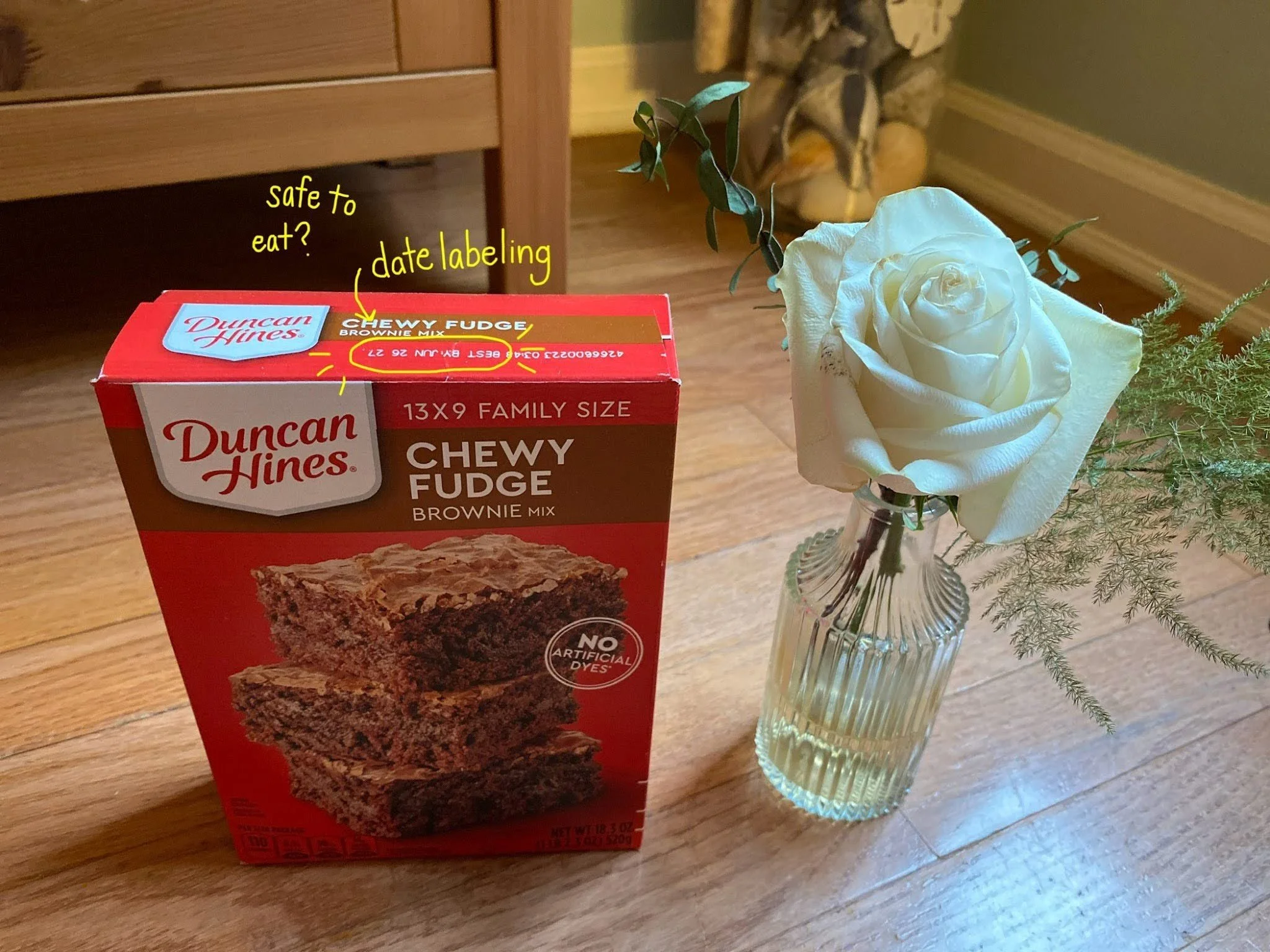
Photo: Kaylin Long
Have you ever checked the expiration date on your food and left feeling more confused? From designations like “best by” to “use by” to “sell by,” it’s easy to be uncertain of what the different labels mean and when food is actually safe to eat. I’ve had my fair share of confusion as I’ve parsed through my own pantry, but with the right information, handling food safety and product date labeling is as easy as cake!
Understanding What Food Date Labels Are
You might be surprised to learn that food date labels are not an indicator of food safety and not required by federal regulation. Instead, these dates represent product quality and are created at a company’s or manufacturer’s discretion, used to indicate how long products have the optimum flavor and best quality (Nicholas, 2024). The only exception to this rule is baby formula–the U.S. Food and Drug Administration does require a “use by” date that indicates the product’s safety, and baby formula past the expiration date should not be used (USDA, 2025).
Types of Food Date Labels
There are two primary styles of food label dating in the United States: open dating and closed dating. Open dating is a calendar date found on most foods–particularly perishable products like meat, poultry, eggs, and dairy products–and is typically phrased like “best by” or “use by.” Meanwhile, closed or “coded” dating is a string of packing letters and/or numbers for manufacturer use and is more typical for shelf-stable items like canned goods (Cornell Cooperative Extension, 2021).
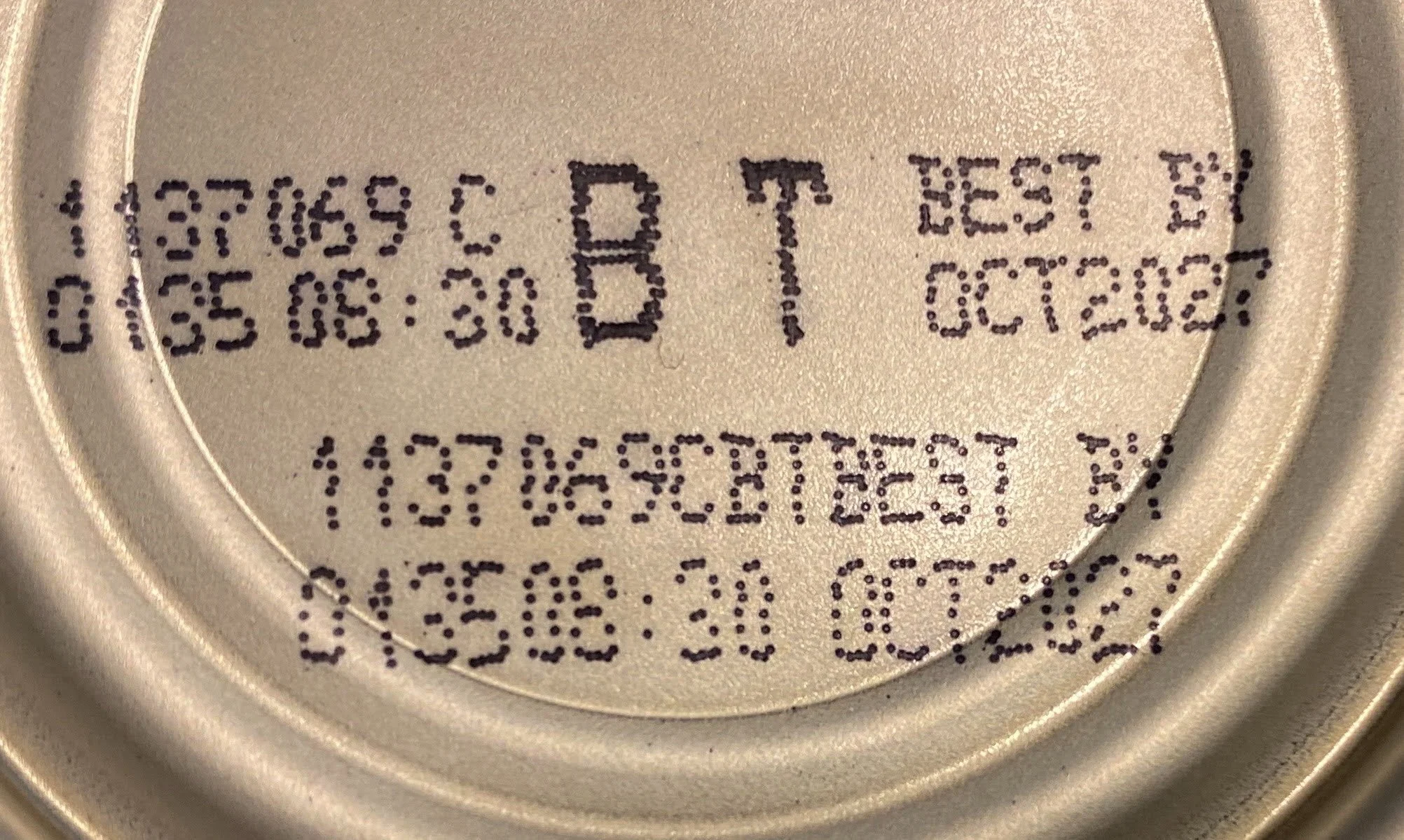
A can lid with both open and closed date food labels.
Photo: Kaylin Long
Because open dating does not have a standard universal description in the United States, you may see many different types of labels. However, here is a guide to some of the commonly used phrases and label types (USDA, 2025):
Best if Used By/Before: This food label indicates the date that the product will no longer have the best flavor and/or quality. It is not a purchase or safety date.
Sell-By: This food label indicates the date that the product should no longer be sold. It is used for inventory management and is not a safety date.
Use-By: This food label indicates the last date recommended to use the product at its optimal quality. It is not a safety date (except for infant formula).
Freeze-By: This food label indicates the date that the product should be frozen to maintain optimal quality. It is not a purchase or safety date.
3-Digit Code Pack Date: This food label is a three-digit code used on egg cartons that have the USDA grade shield. It indicates when the eggs were washed, graded, and packed. This label is not a purchase or safety date.
Why Does It Matter?
Between 30-40% of the entire food supply is wasted in the United States with a 31% food loss at the retail and consumer levels (USDA, n.d.). Some of this waste is a result of consumer confusion around food labeling, and it has implications beyond solely the household. Not only do billions of tons of edible food end up in landfills–food that could have been otherwise directed to feeding over 18 million food-insecure households (Hales & Reed-Jones, 2026)–but production inputs such as water, labor, and energy are also wasted. The consequences of this reality include environmental harm, economic loss, and an increased strain on waste management systems.
On a more individual side, however, it also wastes money. With the average American spending over $10,000 a year and nearly $850 a month for food in 2024 (U.S. Bureau of Labor Statistics, 2025), understanding when to eat and when to toss a food can certainly help your wallet.
How Do I Know if a Food is Safe To Eat?
While food date labels may not tell you when a food spoils, your own senses can. Although the majority of shelf-stable items are safe indefinitely, make sure to look at foods for visible mold, discoloration, or odd textures, and smell to check if the food’s odor is sour or off-smelling. If you find problems in any of these areas, you’re better off throwing away the food (with the exception of hard food items and mold which have specific procedures to discard moldy areas and eat safely) (USDA, 2013). As long as it looks and smells okay, though, you can take a small taste. If it tastes off, toss it!
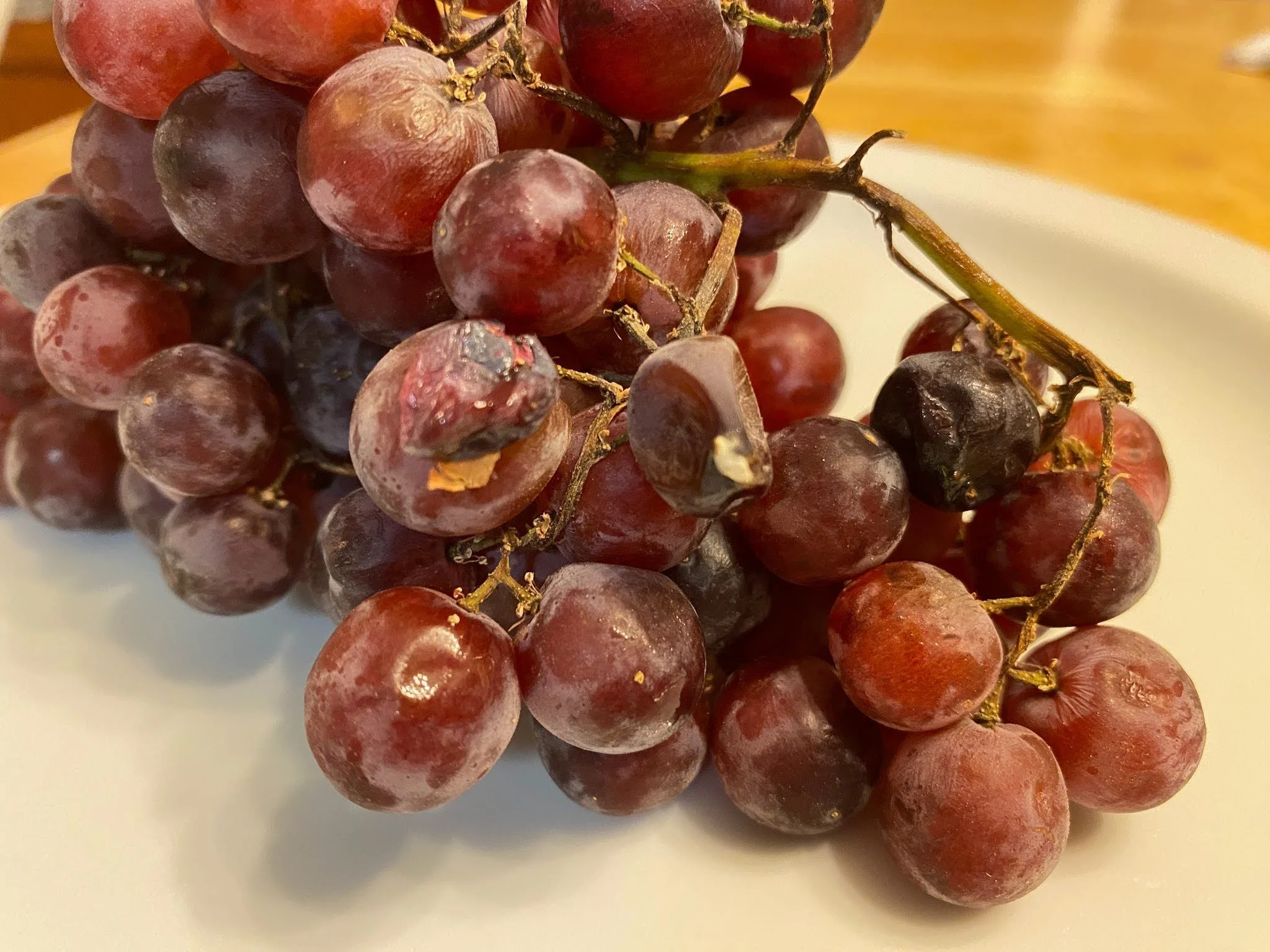
A bunch of red grapes on a plate with some visible white mold.
Photo: Kaylin Long
When in doubt, throw out. As a rule of thumb, if you’re uncertain if a food is good or not after inspecting the item, it’s better to throw it out than risk getting ill.
Here is a guide on how to check some common foods for safety:
Produce: Toss if your food starts to ooze, is unnaturally slimy to touch, and/or if a soft fruit or vegetable has visible mold (appearing as fuzzy spots that are typically white, green, blue, black, or gray). Slight bruising or browning, wrinkling, or slight softening in produce can still be safe to consume but indicates that you should eat it as soon as possible before it goes bad (Gardening at University of Saskatchewan, 2024).
For firm fruits (like apples) and firm vegetables (like cabbages and carrots) with low moisture content, small mold spots can be cut off to ensure the food is safe to eat. Make sure to cut at least 1 inch around the entire mold spot, keeping the knife from touching the actual mold to avoid cross-contamination (USDA, 2013).
Eggs: Toss if the raw eggs have a cracked shell, pink or iridescent egg whites, an unpleasant odor, or unusual textural appearance. Eggs that can float in water indicate poor quality but are still safe to eat (USDA, 2024).
Dairy: Toss if the dairy has a rancid odor, a sour or acidic taste, a slimy/chunky texture, visible mold, and/or a yellow color. These changes indicate that the milk has started to curdle and is unsafe to consume. If the milk is only slightly acidic, however, it can still be used in culinary applications (Hill, 2023).
For hard cheeses (like parmesan) that are not crumbled, shredded, or sliced, mold spots can be cut off to ensure the food is safe to eat. Make sure to cut at least 1 inch around the entire mold spot, keeping the knife from touching the actual mold to avoid cross-contamination. Then, cover the cheese with new wrapping (USDA, 2013).
Meat: Toss if the meat has an unnatural foul odor, a slimy or sticky texture, visible mold, and/or if raw chicken has a greyish hue. A purple or brown color on raw meat (like steak) indicates oxygen exposure and can still be safe to consume, but it should be eaten quickly before spoilage (Australian Institute of Food Safety, 2021).
For hard salami and dry-cured country hams, it is typical to have some surface mold. The mold should be scrubbed off the surface of the firm cured meat to ensure the food is safe to eat (USDA, 2013).
Canned Foods: Toss if the can is swollen, leaking, or deeply dented (small dents are okay) or if the food inside has an unnatural smell, spurting liquid, or mold. Botulism is also a risk with improperly canned foods, occurring most often in home-canning. The toxin that causes this illness cannot be seen, smelled, or tasted. However, following proper food safety practices can help prevent the illness, including boiling home-canned foods for at least ten minutes, storing food in a cool, clean, and dark area, and refrigerating canned foods after opening (CDC, 2024).
Frozen Food: Toss… never! As long as frozen foods are stored continuously at or below 0°F, they are able to be kept indefinitely (USDHHS, 2023). However, if there are any clear signs of spoilage due to improper freezing, make sure to toss. Additionally, it's generally recommended to consume frozen foods within 1–3 months for the best quality, although the ideal storage time varies depending on the type of food (USDHHS, 2023).
Budgeting and Preventing Food Waste
There are many different strategies to save both food and money (including using food safety and labeling knowledge to only toss food when necessary, reducing the amount of food you buy, and making use of grocery store markdowns and discounts). Use the list below to help to prevent resource waste and personal money loss.
Even if the date has passed, the majority of shelf-stable items are safe indefinitely. Inspect foods to see if they are still safe to eat before tossing.
If you often have food going bad, consider adjusting the amount of food you buy at the grocery store. To help make these adjustments, you can note down the foods that you notice going bad and compare them to your grocery list to see what you can buy less (or none of) at your next visit.
Many stores, such as Lowes Food and Food Lion, mark down items when they are close to their labeled best by date that are still perfectly safe to eat. They may also have a specific discounted area that you can purchase from. Take a look and purchase any marked down items you need before shopping for other items.
-
Australian Institute of Food Safety. (2021, October 27). When Raw Meat Changes Colour: How To Check For Safety. https://blog.foodsafety.com.au/raw-meat-changes-colour-check-safety
CDC. (2024). Botulism. https://www.cdc.gov/botulism/prevention/home-canned-foods.html#cdc_generic_section_5-when-in-doubt-throw-it-out
Cornell Cooperative Extension. (2021, July 13). Food Dating. https://westchester.cce.cornell.edu/nutrition-consumer-sciences/food-safety-and-storage/food-dating
Gardening at University of Saskatchewan. (2024, May 31). How to tell imperfect produce from spoiled produce. https://gardening.usask.ca/gardening-advice/gardenline-nested-pages/fitecontent/articles-stretching-food/articles-stretching-food-extending/article-stretchfood-spoiledvsoldproduce.php
Hales, L.J., & Reed-Jones, M. (2026, March 30). Food Security in the U.S. - Key Statistics & Graphics. USDA Economic Research Service. https://www.ers.usda.gov/topics/food-nutrition-assistance/food-security-in-the-us/key-statistics-graphics
Hill, A. (2023, July 5). What Is Spoiled Milk Good For, and Can You Drink It? Healthline. https://www.healthline.com/nutrition/spoiled-milk
Nicholas, K. (2024, June 6). Food Labeling and Allergens. NC Cooperative Extension. https://foodsafetyrepository.ces.ncsu.edu/food-labeling-and-allergens/
U.S. Bureau of Labor Statistics. (2025). Economic News Release. https://www.bls.gov/news.release/cesan.nr0.htm
USDA. (2013, August 22). Molds on Food: Are They Dangerous? https://www.fsis.usda.gov/food-safety/safe-food-handling-and-preparation/food-safety-basics/molds-food-are-they-dangerous
USDA. (2024, November 20). Shell Eggs from Farm to Table. https://www.fsis.usda.gov/food-safety/safe-food-handling-and-preparation/eggs/shell-eggs-farm-table
USDA. (2025, April 23). Food Product Dating. https://www.fsis.usda.gov/food-safety/safe-food-handling-and-preparation/food-safety-basics/food-product-dating
USDA. (n.d.). Food Waste FAQs. https://www.usda.gov/about-food/food-safety/food-loss-and-waste/food-waste-faqs
USDHHS. (2023, September 19). Cold Food Storage Chart. https://www.foodsafety.gov/food-safety-charts/cold-food-storage-charts
Thank you for reading Fresh or Finished? Understanding Food Date Labels. Check out our other Mini Food Guides to continue learning about food.

Kaylin is a UNC student double majoring in Community and Global Public Health and Food, Culture, and Sustainability along with a minor in Italian. She is passionate about bridging her academic interests in public health and food studies, and she hopes to work with community-centered nonprofits and restaurants to address food waste and food insecurity. She is glad to contribute to the Food Equity Collaborative during her time in college!